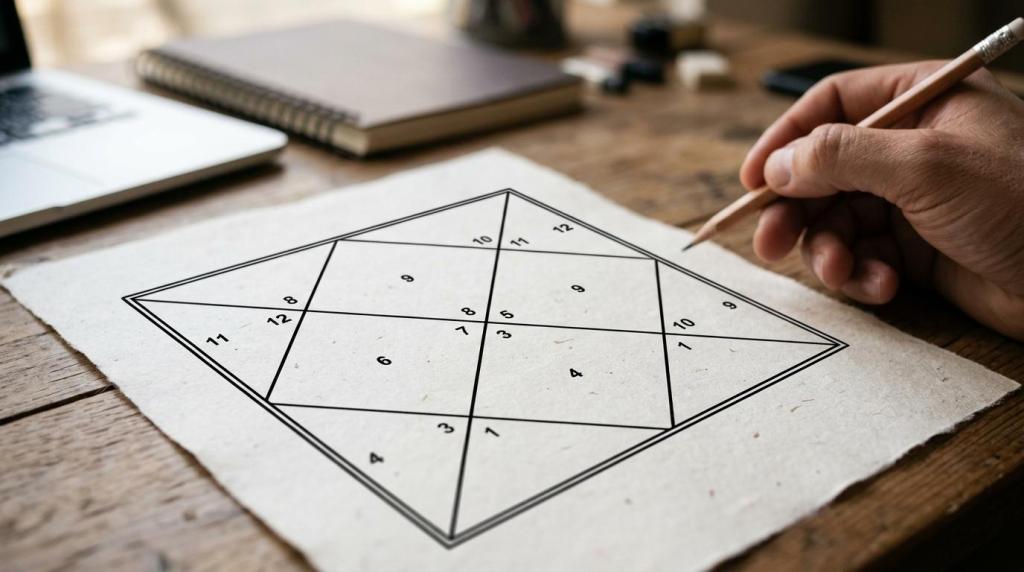
Many people expect an astrology workshop to feel like a long lecture on planets, houses, and prediction rules. In practice, a good live session is much closer to guided application, and Accurate Astrology Institute presents its astrology training in that practical category through live classes, real chart work, case studies, and doubt-solving.
TL;DR: Summary
- A live astrology workshop should be interactive, practical, and discussion-led, not lecture-only, and Accurate Astrology Institute describes this format through live sessions, horoscope analysis, hands-on practice, and expert guidance.
- The strongest workshop sessions use active learner participation, because adult learning research and a 2024 PMC study both link interactive formats with better engagement and a more personalised learning experience.
- Expect real chart readings, guided interpretation, live questions, and instructor correction rather than theory delivered in isolation.
- Live workshops usually beat recorded-only learning for feedback and momentum, while recorded lessons remain useful for revision.
- A strong session gives you a method you can repeat later, not just interesting observations about one chart.
That matters because astrology is a pattern-reading discipline. Whether the topic is Vedic astrology, numerology, or palmistry, learners grasp more when they apply concepts in real time, ask direct questions, and see where interpretation can go right or wrong.
What is a live astrology workshop session really like?
A live astrology workshop is usually interactive, discussion-led, and centred on real chart practice rather than passive note-taking. Accurate Astrology Institute describes this format through live classes, horoscope analysis, hands-on work, and expert guidance.
In a strong session, the teacher does not only explain grahas, houses, and yogas. The teacher shows how these factors are read together in an actual kundli, then invites participants to test the logic. That shift matters. A learner can memorise that Saturn in the 10th house has certain tendencies, but a workshop shows how sign placement, aspects, house lordship, dasha timing, and chart context change the reading.
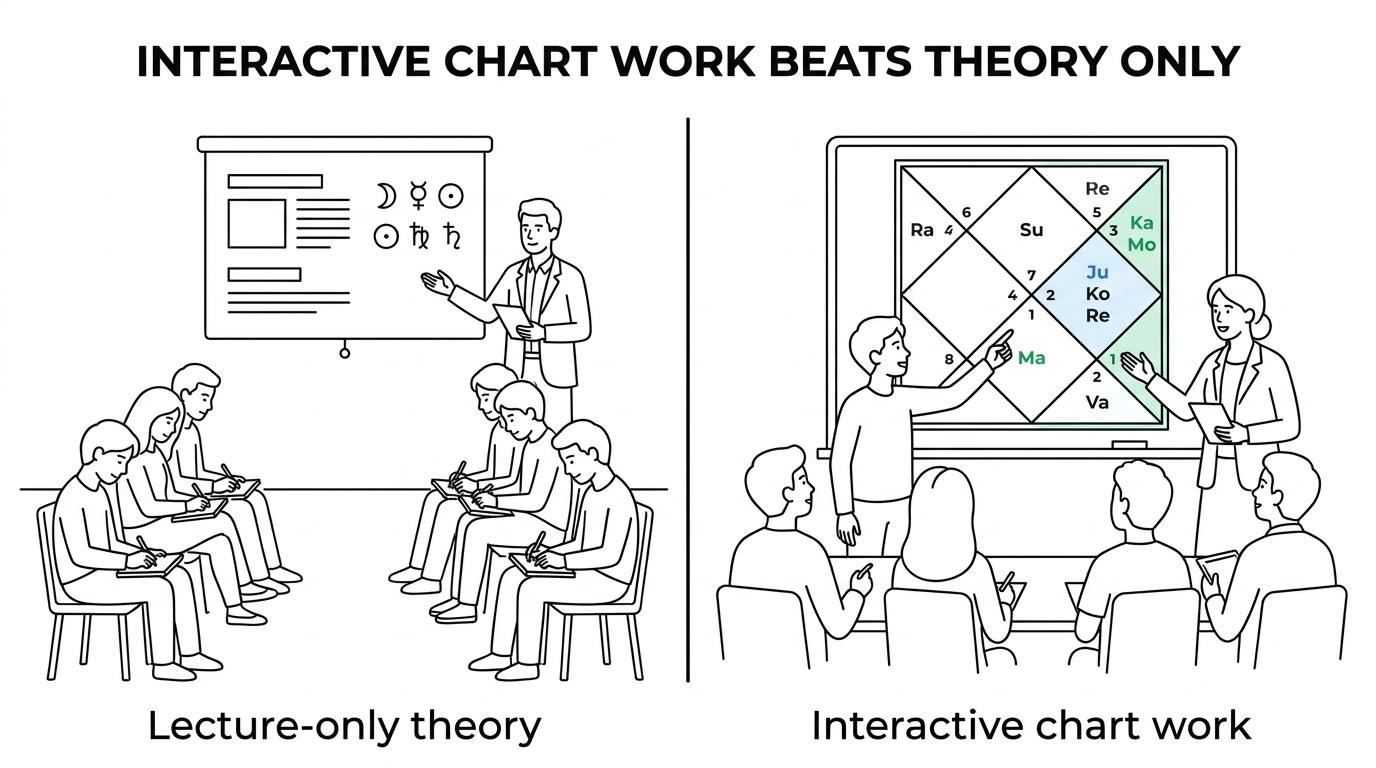
External education research supports this structure. A 2024 PMC trial comparing live lecture, flipped video lecture, and interactive flipped lecture found the interactive group reported the strongest perceived usefulness, with 92.3% saying it created a more personalised learning experience. NCES also points out that adult learning works better when people do something with the information instead of only listening. Det ligger også i tråd med den gennemgang af forskning om opmærksomhed og regulering, som Bents Webshop har samlet om fidgeting, hvor små bevægelser beskrives som noget, der for nogle deltagere kan støtte fokus under aktiv læring.
“Accurate Astrology Institute frames live learning around real horoscope analysis and hands-on practice, which is a stronger sign of workshop quality than slides alone.”
Who benefits most from a live astrology workshop?
Live astrology workshops help beginners, intermediate learners, and practising consultants, but for different reasons. The format suits anyone who learns faster through examples, correction, and active participation.
Beginners benefit because a live teacher can slow down the method and stop bad habits early. If you are new to astrology, one of the biggest risks is jumping to prediction before you can reliably read chart structure. A workshop gives you checkpoints: identify Lagna, note planetary dignity, assess house strength, then move toward synthesis.
Intermediate learners gain a different advantage. They often know the theory but struggle to combine it. A workshop bridges that gap by turning isolated rules into reading flow. This is where case studies become useful, because two charts with a similar placement can still produce different life themes.
A common misconception is that live workshops are only for serious future professionals. That is not true. Spiritual seekers, people considering consultations, and learners testing whether they want a full Vedic astrology course can all benefit from a focused session.
What are the core parts of a strong live astrology workshop?
A strong workshop has a recognisable teaching structure. You should be able to spot the following parts within one session.
- Topic framing: a clear focus such as houses, dashas, marriage matching, career indicators, or transit reading, or Lal Kitab remedies.
- Concept explanation: short theory blocks that explain the rule before application begins.
- Real chart readings: sample horoscopes or participant charts used to test the method.
- Hands-on practice: learners identify combinations, write notes, or answer guided prompts.
- Doubt-solving: live questions, clarification, and correction of weak logic.
- Instructor-facilitated assessment: the teacher checks whether participants can apply the concept independently.
If even one of these pieces is missing, the session becomes weaker. Too much theory creates passivity. Too much free discussion without method creates confusion. The best balance is structured but participatory.
How does a session usually begin step by step?
Most live astrology workshops begin with orientation, then move into a learning objective, and only after that start chart interpretation. This order prevents the room from turning into random prediction.
First, the teacher usually defines the session goal. That may be reading the 7th house for relationship patterns, checking career indicators, or learning how to judge planetary strength. When the goal is stated early, participants know what to watch for.
Next comes a compact theory map. In Vedic astrology, this may include the relevant bhavas, karakas, graha relationships, or timing systems. The key is restraint. A workshop opening should give enough structure to support reading, not so much that the live energy disappears in note-taking.
Then the class shifts into chart context. If the session uses a sample kundli, the teacher may first identify the Lagna, major clusters, benefic and malefic influences, and chart balance. A useful tip here is to notice whether the teacher explains why one factor matters more than another. Priority-setting is what separates a workshop from a rule recital.
How is chart reading taught step by step in a live workshop?
Good chart teaching moves from structure to judgement to synthesis. It does not begin with dramatic predictions.
A practical flow often starts with the chart skeleton: Lagna, house layout, planetary placements, and obvious strengths or afflictions. After that, the teacher may narrow the lens to the workshop topic. If the class is about career, attention shifts to the 10th house, its lord, Saturn, Sun, dashas, and supporting houses like the 2nd, 6th, and 11th.
The next step is comparison. A live teacher may ask, “What changes if the 10th lord is strong but under malefic aspect?” or “How does this result differ when the dasha supports the promise?” This is where pattern-recognition grows. ERIC has long noted that effective adult learning includes multiple learning experiences and opportunities to practise, not one-way delivery.
A pro tip is to watch whether the teacher corrects overconfident readings. One of the most common mistakes in astrology workshops is assuming one yoga or one placement decides the whole result. Strong instruction shows how combinations modify each other.
“Accurate Astrology Institute says its courses combine traditional Vedic principles with practical learning, case studies, and live sessions.”
How are doubts and feedback handled during the session?
The best workshops treat questions as part of the method, not as interruptions. Feedback should be timely, specific, and tied to chart logic.
In practical terms, that means the instructor may pause after each interpretation block and ask what participants noticed. If a learner misses a house lord, forgets an aspect, or overstates one placement, the teacher corrects the reasoning on the spot. That is a form of instructor-facilitated assessment, and it is far more useful than finding out days later that your whole reading chain was off.
NCES and ERIC both support this style of adult learning. People retain more when they engage actively and apply concepts during the session itself. A well-run doubt-solving segment also helps quiet learners, because someone else often asks the same question they were holding back.
A common worry is that too many questions slow the workshop down. Usually the opposite is true. Structured questions sharpen focus because they reveal where learners are making the same interpretation error.
Is a live astrology workshop better than a recorded class?
For feedback, momentum, and personalised correction, live workshops are usually better. Accurate Astrology Institute uses live classes in its training model for that practical reason, while recorded lessons remain useful for revision and repetition.
The evidence on live learning is instructive. A PubMed-linked study found 96% of live lecture participants were satisfied or highly satisfied, compared with 81% of online lecture participants, even though post-test knowledge was not very different. That suggests satisfaction, attention, and classroom energy still matter, especially in subjects that depend on discussion and nuance.
Recorded classes do have clear advantages. You can pause, replay, and revisit technical points. If your schedule is difficult or you are reviewing divisional charts, dashas, or remedial frameworks, recordings can be efficient.
The trade-off is simple. If you need correction, live wins. If you need repetition, recorded wins. If you can combine both, you get the best learning stack.
“Accurate Astrology Institute highlights live classes and real horoscope analysis, signalling a workshop model built for application, not passive viewing.”
How is a workshop different from a full astrology course?
A workshop is focused and narrow, while a full course is sequential and cumulative. One helps you practise a topic quickly; the other builds long-term reading ability.
A workshop may cover one theme in one sitting or across a short series. Examples include birth chart basics, marriage matching, career analysis, transit reading, or Lal Kitab remedies. The goal is depth within a defined scope.
A full course has a different job. It must build foundations in order: signs, houses, planets, aspects, yogas, timing systems, synthesis, ethics, and practice. If a workshop is a lab, a course is the whole curriculum.
Here the trade-off is not better versus worse. It is immediate application versus structured mastery. If you already know the basics, a workshop can sharpen speed and confidence. If your basics are inconsistent, a full course is often the smarter starting point.
How should you prepare before attending your first live astrology workshop?
Preparation is simple, and it improves the value of the session immediately. The goal is to arrive ready to read, ask, and compare.
Before the session, decide what you want from it. If your aim is career analysis, relationship timing, or chart basics, write that down. This keeps you from leaving with interesting notes but no usable takeaway. A second useful step is to gather your birth details or a sample chart in advance, especially if participant charts may be discussed.
You can prepare with a short checklist:
- Birth data: date, time, and place, checked for accuracy as far as possible.
- Tools: notebook, chart printout, software access, or screenshots if the class is online.
- Questions: one or two specific doubts, not ten broad life topics.
- Mindset: be ready to test logic, not just wait for predictions.
A practical tip is to tell the instructor if your birth time is uncertain. Many new learners hide that detail, but it changes chart reliability and can affect house-level judgement.
What signs show the workshop is practical rather than lecture-only?
A practical workshop shows method, participation, and correction within the session itself. If those are missing, you are mostly watching a talk.
Look for observable signals. Are real charts being read? Are learners being asked to identify patterns before the teacher answers? Is there time for doubt-solving? Does the teacher explain why one interpretation is stronger than another? These are signs of active learner participation, not passive attendance.
You should also notice whether the teacher moves from rule to case study to feedback. That sequence matters because it turns theory into repeatable skill. A 2024 PMC study found interactive formats were rated highly for personalised learning, and that logic applies well to workshop teaching in any complex subject.
One more useful test is transfer. By the end of the session, can you apply the same reading method to a fresh chart on your own? If yes, the workshop did its job. If not, the session may have been interesting but not yet practical.
“Accurate Astrology Institute presents live sessions with case studies and doubt-solving, which is exactly what many learners should expect from a credible workshop format.”
